Foundational Methodology
The STRT Model
Developed by Dr. Martin Kaufmann, PhD, LPC-S, the Sub-perceptual Tendency Resolution and Transformation (STRT) Model is a first-of-its-kind integrative methodology that brings together neuroscience, psilocybin-assisted therapy, the Enneagram, and modern therapeutic frameworks into a single, coherent, and clinically rigorous operating system. STRT is designed to produce real transformation, predictably, measurably, at the foundational level.
The Model
A Groundbreaking System for Clinicians and Clients
"STRT is not a loose mixture of theories. It is a coherent system that gives neuroscience, modern therapy, and psilocybin-assisted work an organized, clinically useful structure and makes transformation predictable rather than accidental."
STRT is an emerging next-generation model of therapy and transformation. It is clinically sophisticated, neuroscience-informed, and designed for practitioners and individuals who require more than symptom management, who require a system capable of producing lasting, verifiable change at the level of identity, pattern, and neurological functioning.
STRT Is Defined By
Clinically sophisticated
Neuroscience-informed
Trauma-aware
Integration-focused
Predictive in its structure
Practical in its application
Spiritually and existentially open
Designed for real transformation, not symptom management alone
The STRT Structure
The Perceptual Threshold
At the core of STRT is the Perceptual Threshold. This is the boundary between the reactive coping loop and true transformation. Above the threshold, unresolved internal activation drives a repeating maladaptive coping loop. Below the threshold lies the transformational pathway, where lasting change becomes possible.
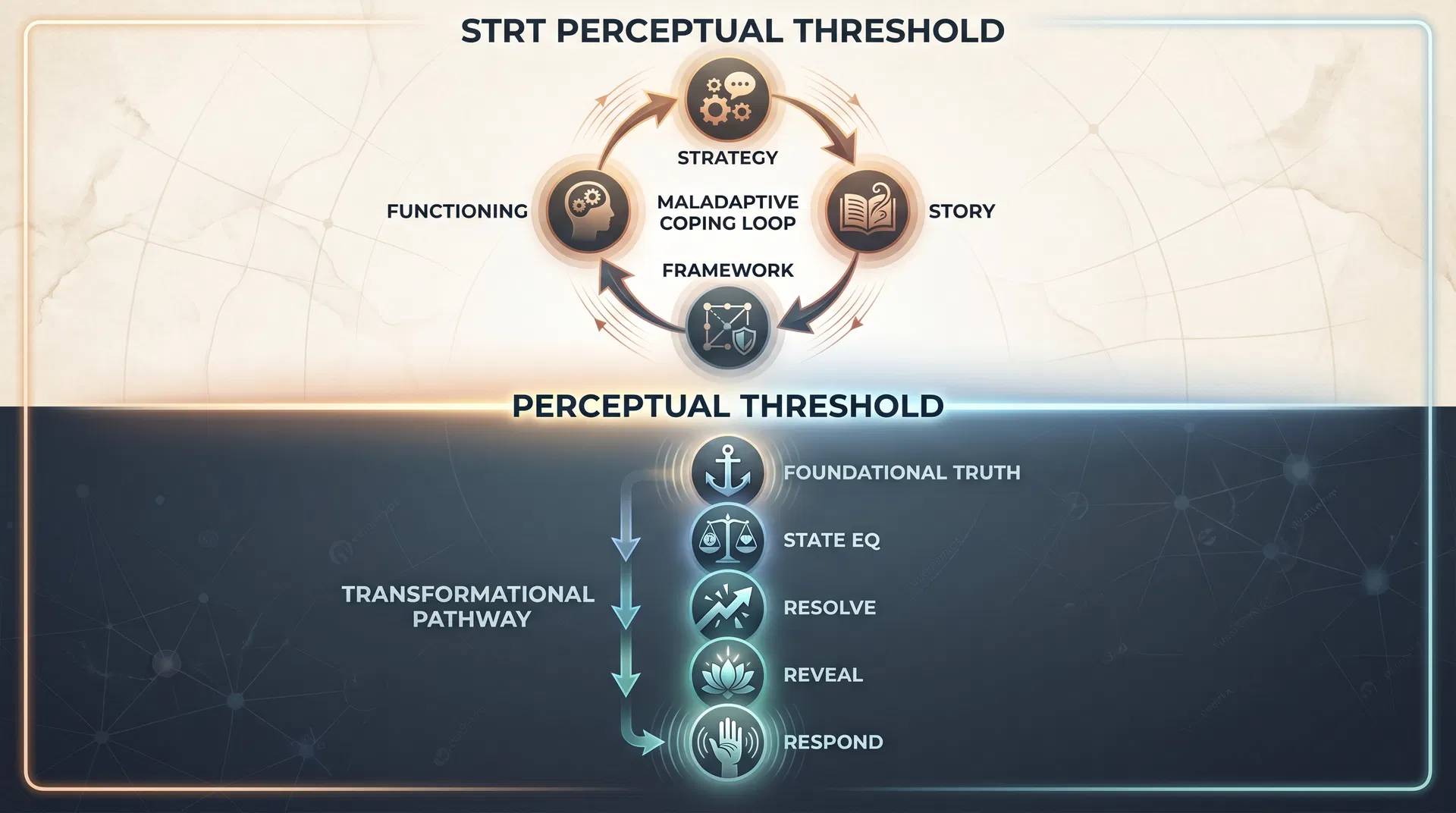
Above the Threshold
The Maladaptive Coping Loop
When internal states remain unresolved, activation rises above the perceptual threshold and enters a repeating loop driven by story-based interpretation and survival functioning. The four elements of this loop: Strategy, Story, Framework, and Functioning reinforce one another in a self-sustaining cycle that repeats regardless of effort or intention.
Below the Threshold
The Transformational Pathway
True transformation begins below the threshold with Foundational Truth, the deepest layer of self-knowledge. From there, State EQ resolves internal activation, Resolve addresses unfinished emotional and relational material, Reveal surfaces meaning, purpose, and direction, and Respond establishes a new, truth-based behavioral pattern in place of the reactive coping loop.
The Central Mechanism
State EQ
Within the STRT model, State EQ occupies a central position in the transformational pathway. It refers to a person's growing capacity to recognize, resolve, interpret, and work with their internal emotional, physical, physiological, and psychological state. State EQ is not a static trait. It is a developed capacity that expands through the structured work of the STRT process.
In STRT, State EQ is foundational because transformation cannot occur through insight or strategy alone. Understanding a pattern intellectually is insufficient if the internal state driving that pattern remains unresolved. Change must move through state awareness, state regulation, and state resolution, not around it.
State EQ Encompasses
Emotional State
Recognition and resolution of emotional activation
Physical State
Body-based awareness and somatic resolution
Physiological State
Nervous system awareness and physiological resolution
Psychological State
Identification and resolution of state-driven thought patterns
"Transformation cannot occur through insight or strategy alone. It must move through state awareness and resolution — across all four dimensions of state."
Integration Architecture
Four Domains of Integration
01
Neuroscience
STRT is grounded in a rigorous understanding of brain-based functioning, nervous system regulation, and sub-perceptual tendencies. The model accounts for state-based processing, predictive patterning, and the ways in which brain and body states shape perception, meaning-making, behavioral decisions, and relational dynamics. Transformation in STRT is not conceptual, it is neurological.
02
Psilocybin-Assisted Therapy
STRT is uniquely structured to work alongside psilocybin-assisted therapy as a deliberate, sequenced clinical tool, not a source of random insight. Three progressive sessions within the cohort experience use psilocybin to reveal deeper truths, interrupt maladaptive coping loops, and catalyze neuroplasticity in support of lasting change.
03
Modern Therapy Models
STRT integrates and organizes insights from Internal Family Systems, Narrative Therapy, Choice Theory, ACT, CBT, REBT, DBT, Polyvagal Theory, and Interpersonal Neurobiology. The Enneagram serves as an additional interpretive framework for identifying motivational styles, protective tendencies, and relational patterns. STRT is not a loose mixture of these approaches, it is a coherent system that gives them organized, clinically useful structure.
04
Predictive Methodology
STRT functions as a concise predictive methodology. By mapping how unresolved states, narratives, and coping frameworks shape behavioral probabilities, clinicians and clients gain the ability to anticipate patterns before they recur. The model moves the person from reactive coping, driven by story and survival functioning, into truth-based responding grounded in state awareness and resolution.
Psilocybin-Assisted Therapy
Three Progressive Sessions
Within the ReBuild cohort experience, psilocybin-assisted therapy is not a standalone intervention. It is a sequenced, clinically structured series of three sessions. Each building on the previous, these sessions are designed to deepen the work of the STRT process and catalyze transformation at a neurological level.
01
Very Low DosePrep-Journey
The first psilocybin session is administered at a very low dose and used during the timeline extraction and healing session. It gently opens access to memory, emotion, and pattern recognition, allowing clients to begin surfacing the material that will be worked with throughout the cohort experience.
02
Therapeutic DosePre-Journey
The second session uses a therapeutic dose of psilocybin in conjunction with trauma-informed and strength-based therapy models. This session is designed to help clients integrate the findings and developments from the Prep-Journey, deepen self-understanding, and begin resolving the patterns that have been identified.
03
Macro DoseThe Journey
The full-day Journey session uses a macro dose of psilocybin to guide the client into deep self-knowledge, accessing foundational truth, establishing neuroplasticity, and opening the brain and mind to significant, lasting change. This is not an unstructured experience; it is the culmination of a carefully sequenced clinical process.

About the Developer
Dr. Martin Kaufmann
PhD · LPC-S · Neurotherapist
Dr. Martin Kaufmann is a Licensed Professional Counselor Supervisor, Neurotherapist, and Adjunct Faculty member at Colorado Christian University. His clinical career has been defined by a sustained commitment to understanding the deeper architecture of human behavior, the underlying operation systems that produce tendencies, and to developing systems capable of producing change that is both rapid and lasting.
The STRT Model represents the culmination of Dr. Kaufmann's clinical research and practice. An original, proprietary methodology that integrates neuroscience, psilocybin-assisted therapy, the Enneagram, and the most clinically rigorous elements of modern therapeutic practice into a unified system. STRT is not derived from any single existing model. It is a new framework, developed to address the limitations of conventional approaches and to make transformation predictable rather than incidental.
Through ReBuild, Dr. Kaufmann brings the STRT Model into direct clinical application, offering individuals a structured, intensive, and measurable path to genuine transformation. His work is grounded in the conviction that meaningful change should be verifiable, that the brain and body are central to that process, and that the right system, applied with clinical precision, can compress years of work into days.
PhD
Licensed Professional Counselor Supervisor (LPC-S)
Neurotherapist
Adjunct Faculty, Colorado Christian University
Developer of the STRT Model
Begin
Ready to Learn More?
A ReBuild consultation is a direct conversation about your specific situation and whether the program is the right fit. No pressure. Only clarity.